
Scalp Education
What To Put On Your Scalp Between Medicated Washes
•5 min read
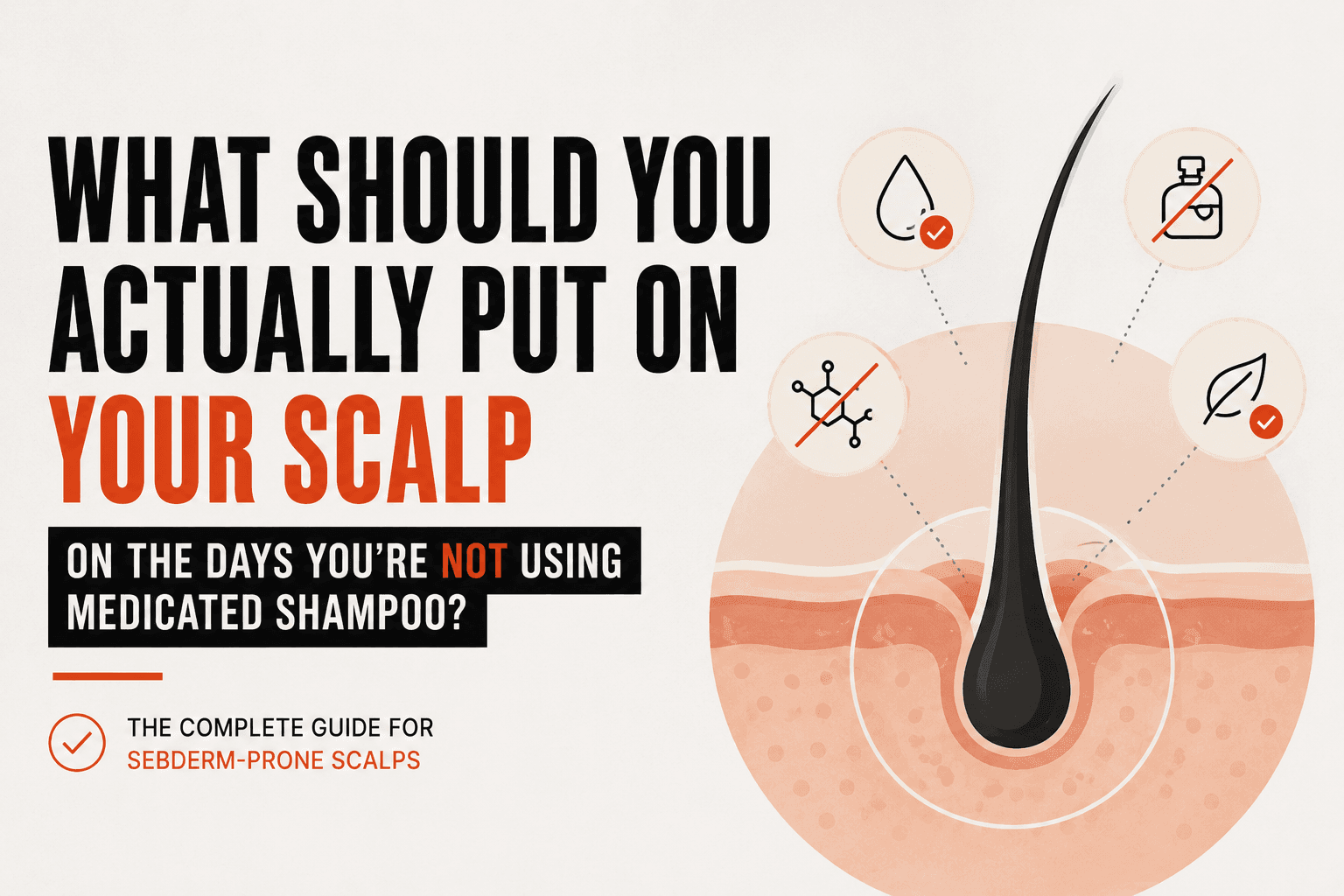
Think about yesterday.
If it wasn't a wash day, what touched your scalp?
Most people go quiet at this point. Because the honest answer is: nothing deliberate. Whatever the last shampoo left behind. A regular conditioner. Maybe dry shampoo. Or genuinely nothing at all.
And nobody has ever pointed at that and called it a problem.
It is.
Your scalp doesn't stop on the days you skip the ketoconazole.
Sebum production keeps going. The pH shifts. Malassezia starts climbing again within 48 hours of your last medicated wash.
The off days are not neutral.
They're an environment your scalp is navigating completely on its own. And for most people with sebderm, that environment is UNMANAGED.

Let's name it.
A regular shampoo that strips. Most mainstream shampoos weren't designed for a sebderm-prone scalp. They clean. They also disrupt. They don't account for a scalp that's already reactive.
A conditioner full of oils your scalp can't tolerate. Malassezia feeds on most long-chain fatty acids. Coconut oil. Olive oil. Argan oil. Jojoba. These are some of the most recommended scalp ingredients on the internet. For a sebderm-prone scalp, they're FUEL.
Dry shampoo. One of the worst things you can put on a reactive scalp. It sits on the skin. Clogs. Creates exactly the conditions where fungal growth accelerates.
Or nothing. Which at least doesn't add variables. But leaves the scalp completely without support.
None of these are right. But they're the ONLY options most people have.
Not because they're making bad choices. Because nothing better was ever built for this specific gap.
Not another active.
Not a second round of treatment. Not more chemicals doing more work. That's the cycle that leads to a compromised barrier and a scalp that reacts to everything.
What the scalp needs between washes is stability.
An environment that doesn't swing. That doesn't strip on one end or load up with ingredients that feed the problem on the other.
That means fewer ingredients. Every ingredient is a variable. The more variables touching a reactive scalp, the more chances for something to go wrong. On off days, LESS is the answer.
It means nothing that feeds Malassezia. If you're putting oils on your scalp on the days between washes, check what's in them. Most will feed the problem you're trying to manage.
It means something designed for DAILY use. Not a treatment. Something your scalp can tolerate consistently without the kind of stripping or irritation that sets off a flare.

Start with the ingredient list. Before anything else.
The first thing to check - is there an oil in it? And if so, which one?
Most oils are long-chain fatty acids. Coconut oil. Olive oil. Argan oil. Jojoba. These are the ones that feed Malassezia. If they're in the first few ingredients, put it back.
MCT oil is different. It's a medium-chain fatty acid. The research on Malassezia and lipids suggests it doesn't behave the same way as long-chain oils. For a sebderm-prone scalp looking for something to use between washes, it's one of the few oils worth considering.
Beyond that, the criteria are simple.
Short ingredient list. If you can't read it in ten seconds, it has too much in it. Every extra ingredient is something your scalp has to process. On off days, you want nothing your scalp doesn't need.
No fragrance. Fragrance is one of the most common irritants on a reactive scalp. There is no reason for it to be in a product designed for daily use on sensitive skin.
Non-medicated. The off days are not the time to stack more actives. You want something that maintains, not treats. Something that keeps the environment stable without adding another chemical layer on top of what you're already using.
That's the framework. Fewer ingredients. No Malassezia-feeding oils. No fragrance. Non-medicated. Designed for daily use.
It's a short list. But almost nothing on the market meets it.
The market split scalp care into two categories.
Medicated products. And everything else.
The medicated side is well-developed. Ketoconazole. Zinc pyrithione. Selenium sulfide. These work. They were designed to treat.
The everything else side was designed for general hair care. Not for a sebderm-prone scalp specifically. Not for the days between washes. Not for someone who already has a treatment routine and needs something to sit alongside it.
The gap between those two categories - non-medicated products built specifically for this scalp type, for daily use, for the off days - is almost EMPTY.
Which is why most people default to nothing. Or to products that quietly make things worse.
That's not a failure of your scalp.
That's a failure of the market.
The off days matter as much as the wash days.
Your medicated shampoo does its job on the days you use it. It clears the fungal load. It buys you a window.
But that window closes faster than it should when the days in between are left unmanaged.
Fill those days deliberately. With fewer ingredients. With nothing that feeds the problem. With something that was actually designed for your scalp.
Not a treatment. The thing you use on the OTHER days.
THAT is the gap. And THAT is what your routine has been missing.
__________________________________________________________________________________________
Ritualist makes non-medicated, daily-use products designed specifically for seborrheic dermatitis and dandruff-prone scalps. For the days between treatments.
Ritualist MCT Scalp Moisturizer: non-medicated, daily-use scalp care for sebderm and dandruff-prone scalps.
A practical, evidence-based guide to understanding modern seborrheic dermatitis management, what current treatments do well, where they have limits, and how to think about long-term care.

If your sebderm keeps flaring even though you're using ketoconazole correctly, the shampoo isn't the problem. Here's what's actually missing from your routine.