
Scalp Education
Seb Derm Scalp Treatment: The Complete Evidence-Based Guide (2026)
•16 min read
Most people think seb derm treatment is about finding the right shampoo.
Use ketoconazole.
Wait for the flakes to disappear.
Then hope they don't come back.
The problem is...
They usually do.
So you switch shampoos.
Or use them more often.
Or spend another night reading Reddit, convinced there's one ingredient you've somehow missed.
For a while, I thought the same thing.
That if I could just find the right treatment, the cycle would finally stop.
The biggest mistake isn't choosing the wrong treatment.
It's expecting treatment to do a job it was never designed to do.
The research tells a more interesting story.
Modern evidence no longer looks at seborrheic dermatitis as a condition explained by a single factor. Malassezia still matters. Medical treatment still matters. But researchers now also discuss skin barrier function, immune responses, individual susceptibility, and the overall scalp environment as parts of the picture.
That changes how you think about treatment.
Because if seborrheic dermatitis is a chronic condition, then managing it isn't only about what you do during a flare-up.
It's also about everything that happens in between.
This guide isn't about replacing medical treatment.
Nothing here should be interpreted that way.
It's about understanding what current evidence says.
Where medicated treatments fit.
What they don't aim to do.
And how to build a long-term strategy that makes more sense than constantly chasing the next shampoo.
Because once you understand the condition differently,
your routine starts looking different too.
If you've been living with seb derm for a while, the routine probably feels familiar.
A flare starts.
You reach for the medicated shampoo.
Things improve.
Life feels normal again.
Then a few weeks later, the flakes come back.
So you repeat the process.
Over time, it starts to feel like you're managing symptoms instead of making progress.
That's frustrating.
It also makes it easy to believe that the answer is simply finding a stronger product.
A different shampoo.
A better ingredient.
A new routine someone recommended online.
Sometimes that helps.
Sometimes it doesn't.
The difficult part is that seborrheic dermatitis is a chronic condition.
It behaves differently from a problem you solve once and never think about again.
That's why the goal isn't just making a flare disappear.
It's understanding what keeps the cycle going in the first place.
Because once you understand the cycle,
you stop chasing products.
You start building a strategy.
The goal isn't to win one good week.
The goal is to build a routine that still makes sense six months from now.

Medical treatments are one of the most important parts of managing seborrheic dermatitis.
They're also one of the most misunderstood.
Many people expect treatment to solve the condition permanently.
That's not what most treatments are designed to do.
Their primary job is to reduce the inflammation and other processes that are driving an active flare.
Depending on your treatment plan, that might include antifungal shampoos, topical corticosteroids, calcineurin inhibitors, or other therapies recommended by your dermatologist.
When they're used appropriately, they can be remarkably effective at calming symptoms.
The problem isn't that these treatments don't work.
It's expecting them to do everything.
Seborrheic dermatitis is a chronic condition.
Most chronic conditions aren't managed with a single intervention.
They require a strategy.
Current clinical guidance reflects that idea.
Treatment is often divided into two phases.
The first is getting the flare under control.
The second is maintaining those results over time while reducing the chance of future flare-ups.
That distinction changes everything.
Because once the flare improves,
the question isn't,
"What should I stop doing?"
It's,
"What should I keep doing?"
That's where long-term management begins.
Medical treatment manages the flare.
Long-term management is about what comes next.

If seborrheic dermatitis were caused by a single problem,
there would probably be a single solution.
That's not what the research shows.
Modern research describes seborrheic dermatitis as a condition influenced by several interacting factors.
Malassezia plays an important role.
So does the skin barrier.
Your immune response matters too.
Genetics.
Skin oil production.
Environmental triggers.
Even stress can influence when symptoms become worse for some people.
None of these factors exist in isolation.
They interact with each other.
That's one reason seborrheic dermatitis behaves differently from a condition that can simply be "fixed."
It can improve significantly.
It can stay quiet for long periods.
But because the underlying biology doesn't suddenly disappear, flare-ups can still happen.
That's why modern management isn't only focused on treating today's symptoms.
It's also about creating the conditions for a healthier, more resilient scalp over the long term.
This doesn't mean every flare-up can be prevented.
It doesn't mean you've done something wrong if symptoms return.
It means the goal changes.
Instead of asking,
"How do I make this disappear forever?"
A more useful question becomes,
"How do I give my scalp the best chance to stay calm for as long as possible?"
That's a very different mindset.
And it's much closer to how modern seborrheic dermatitis is understood.
Seb derm isn't one problem.
It's a collection of interacting processes.
Good management respects that complexity.

For years, seborrheic dermatitis was often discussed as if one thing explained everything.
Malassezia.
And to be clear,
Malassezia is important.
Research consistently shows that it plays a central role in seborrheic dermatitis.
But that's only part of the story.
If Malassezia alone explained the condition,
everyone with the yeast would develop seb derm.
They don't.
In fact, Malassezia is a normal part of the skin microbiome.
It's found on the scalps of people with seb derm.
It's also found on people who have never experienced a flare.
That tells us something important.
The presence of the yeast isn't the only factor.
It's how your scalp responds to it.
That's where modern research has shifted.
Instead of asking,
"How do we get rid of Malassezia?"
Researchers now ask a broader question.
"Why does Malassezia trigger inflammation in some people but not others?"
That question has opened the door to a more complete understanding of seborrheic dermatitis.
One that includes the skin barrier.
The immune system.
Sebum production.
Genetics.
And the way all of these factors influence each other.
That's a much more useful way to think about the condition.
Because it explains why one treatment rarely solves everything.
And why long-term management is about supporting the entire scalp environment, not focusing on a single factor.
Malassezia matters.
It's just not the whole story.

Most people think about their scalp in terms of what they can see.
Flakes.
Redness.
Itching.
Oiliness.
Those are the visible parts of seb derm.
The skin barrier is different.
You can't see it.
But it's quietly influencing everything happening above it.
Think of it like the operating system of your scalp.
You rarely think about the operating system on your computer.
Until it stops working properly.
Then suddenly,
every app starts behaving differently.
The same thing happens here.
A healthy skin barrier helps regulate moisture.
It acts as a physical shield.
It influences how your scalp responds to the outside world.
And it helps maintain an environment where the skin can function normally.
When that barrier becomes disrupted,
the scalp becomes more vulnerable.
Water escapes more easily.
External irritants have an easier path in.
Inflammatory signals become more active.
The environment changes.
That matters.
Because modern research suggests seborrheic dermatitis isn't simply about what's living on the surface of your scalp.
It's also about the condition of the surface itself.
That's one reason skin barrier function has become an increasingly important area of seborrheic dermatitis research.
Researchers are beginning to view the barrier not as a consequence of the disease alone,
but as part of the conversation.
That doesn't mean repairing the barrier replaces medical treatment.
It doesn't.
But it does help explain why long-term management is about more than treating visible symptoms.
It's about supporting the environment those symptoms develop in.
Once you start looking at your scalp this way,
something changes.
You stop asking,
"What's the strongest product I can use?"
And start asking,
"What kind of environment am I creating for my scalp every day?"
That's a much better question.
You're not just treating symptoms.
You're supporting the environment they develop in.

For a long time, I judged my routine by one question.
"Did my seb derm disappear?"
If the answer was yes,
I felt like everything was working.
If it came back,
I assumed I'd failed.
Or that I needed a stronger treatment.
Over time, I realized that was the wrong way to measure progress.
Seborrheic dermatitis isn't a condition where success always means having perfect skin every single day.
It's a condition where the goal is often to reduce the frequency, severity, and impact of flare-ups over time.
That's a different target.
And it's a much more realistic one.
A good routine won't guarantee that your scalp never flares again.
No dermatologist can honestly promise that.
No product should promise it either.
What a good routine can do is give your scalp a better environment to function in between flares.
It can support the skin barrier.
It can help you stay consistent.
And it can make it easier to respond early when symptoms begin to return.
That's what long-term management looks like.
Not chasing perfection.
Building resilience.
Once you start measuring success that way,
small improvements stop feeling insignificant.
Longer periods between flares matter.
Less itching matters.
Needing prescribed treatment less often matters.
Feeling more confident about your routine matters.
Those wins count.
Probably more than you think.
The goal isn't a perfect scalp.
The goal is a more resilient one.

Once you stop thinking about seb derm as something to "fix,"
your routine starts looking different.
Instead of asking,
"What's the next product I should buy?"
You start asking,
"What does my scalp need over the next six months?"
That's a much better question.
Because long-term management isn't one decision.
It's dozens of small decisions,
repeated consistently.
Knowing when to use your prescribed treatment.
Being gentle with your scalp between flares.
Supporting the skin barrier instead of constantly disrupting it.
Learning which habits seem to make your own symptoms worse.
Accepting that occasional flare-ups don't mean your routine has failed.
None of those ideas are particularly exciting.
That's exactly why they work.
Consistency rarely feels dramatic.
But chronic conditions are rarely improved by dramatic decisions.
They're usually improved by sustainable ones.
That's one reason dermatologists often think in terms of maintenance, not just treatment.
The goal isn't to constantly react.
It's to reduce the number of times you need to.
Over time,
those small decisions start compounding.
One fewer flare.
A slightly calmer scalp.
Less itching.
Longer periods where you don't think about your condition at all.
That's progress.
And for many people,
that's a far more meaningful goal than endlessly searching for a permanent cure.
Your routine shouldn't only help during a flare.
It should make life between flares better too.

Living with seb derm usually teaches you one thing.
You'll try almost everything at least once.
A new shampoo.
A viral ingredient.
A routine someone swears by online.
Sometimes that's how you find what works.
Sometimes it's how you make your scalp even more confused.
Over time,
a few patterns appear again and again.
A stronger product isn't always the missing piece.
Sometimes the missing piece is consistency.
Sometimes it's understanding when to treat a flare,
and when to support your scalp between them.
It's tempting to judge a product after a few days.
Or abandon a routine the moment symptoms improve.
Seborrheic dermatitis rarely rewards constant experimentation.
Your scalp needs time to respond.
Many people only think about their scalp when it's itching.
Those quiet days matter too.
They're when long-term habits are built.
No routine can promise you'll never flare again.
That's not a realistic standard.
A better question is:
"Am I doing better than I was three months ago?"
That's how progress is measured with most chronic conditions.
Seb derm is no different.
The biggest mistake isn't having a flare.
It's believing one flare means you've failed.
I don't think about seb derm as a battle anymore.
Because battles imply there's a final victory.
One day you win.
And it's over.
That's not how most chronic conditions work.
They're relationships.
Some days are easier.
Some days are frustrating.
Some weeks you barely think about your scalp.
Other weeks remind you it's still there.
That's okay.
The goal was never to control every single flare.
The goal was to stop letting every flare control you.
That's a very different way to live with a chronic condition.
Modern research has helped us understand seborrheic dermatitis in a much more complete way.
Not as a single yeast.
Not as a single shampoo.
Not as a single miracle ingredient.
But as a condition shaped by biology, the skin barrier, immune responses, daily habits, and medical care working together.
Ironically,
that makes the solution feel simpler.
Not easier.
Simpler.
Treat active flares appropriately.
Look after your scalp between them.
Stay consistent.
Give your routine time to work.
Adjust when you need to.
Then get on with your life.
Because the best routine isn't the one you think about all day.
It's the one that quietly lets you think about everything else.
Winning isn't having a perfect scalp.
Winning is reaching a point where your scalp no longer occupies your mind every day.
Seborrheic dermatitis is generally considered a chronic condition. While medical treatments can effectively control active flare-ups and many people experience long periods with few or no symptoms, there is currently no universally accepted permanent cure. The focus is usually on long-term management rather than permanent elimination.
Current research suggests that seborrheic dermatitis develops through the interaction of several factors rather than a single cause. These include Malassezia yeast, skin barrier function, immune responses, sebum production, genetic susceptibility, and environmental triggers. The way these factors interact differs from person to person.
Malassezia plays an important role, but it isn't the whole story. The yeast is a normal part of the skin microbiome and is found on many healthy scalps. Current evidence suggests that how your scalp responds to Malassezia is just as important as the presence of the yeast itself.
Seborrheic dermatitis is a chronic inflammatory condition. Medical treatments can effectively control active flare-ups, but the underlying factors that contribute to the condition may still be present. That's why long-term management focuses on reducing the frequency and severity of flare-ups rather than expecting them never to return.
Healthy skin barrier function is increasingly recognized as an important part of seborrheic dermatitis management. Supporting the skin barrier does not replace prescribed medical treatment, but current research suggests it may contribute to a healthier scalp environment as part of a comprehensive long-term care strategy.
Dandruff is generally considered a milder form of seborrheic dermatitis that mainly affects the scalp without significant inflammation. Seborrheic dermatitis may involve more noticeable redness, irritation, itching, and can affect other oil-rich areas of the body, such as the eyebrows, sides of the nose, ears, and beard area.
The appropriate frequency depends on your dermatologist's recommendations, the severity of your symptoms, and the specific product you're using. Many treatment plans involve more frequent use during active flare-ups followed by a maintenance schedule, but you should always follow the instructions provided by your healthcare professional.
Many people notice that stress appears to coincide with worsening symptoms. While stress is not considered the sole cause of seborrheic dermatitis, it is recognized as one of several factors that may contribute to flare-ups in susceptible individuals.
Not necessarily. Many treatment plans include both an active treatment phase and a maintenance phase. Your dermatologist may recommend continuing certain treatments or adjusting your routine after symptoms improve to help maintain remission. Always follow your prescribed treatment plan.
The periods between flare-ups are an important part of long-term management. Many people focus on maintaining a gentle scalp care routine, supporting the skin barrier, avoiding unnecessary irritation, and following any maintenance plan recommended by their dermatologist.
Galizia G, Belloni Fortina A, Semenzato A. Seborrheic Dermatitis: From Microbiome and Skin Barrier Involvement to Emerging Approaches in Dermocosmetic Treatment. Cosmetics. 2024;11(6):208.
Visit paper: MDPI Full Article
DOI: https://doi.org/10.3390/cosmetics11060208
Clark GW, Pope SM, Jaboori KA. Diagnosis and Treatment of Seborrheic Dermatitis. American Family Physician. 2015;91(3):185–190.
Visit article: American Family Physician Article
Rousel J, Nădăban A, Saghari M, et al. Lesional Skin of Seborrheic Dermatitis Patients Is Characterized by Skin Barrier Dysfunction and Correlating Alterations in the Stratum Corneum Ceramide Composition. Experimental Dermatology. 2024;33:e14952.
Visit paper: PubMed Record
DOI: 10.1111/exd.14952
Vijaya Chandra SH, Srinivas R, Dawson TL Jr, Common JEA. Cutaneous Malassezia: Commensal, Pathogen, or Protector? Frontiers in Cellular and Infection Microbiology. 2021;10:614446.
Visit paper: Frontiers Article
Adult and Infantile Seborrheic Dermatitis: Update on Current State of Evidence and Potential Research Frontiers. International Journal of Dermatology. 2024.
Visit paper: PubMed Record
This article is intended for educational purposes only and should not be considered medical advice.
Seborrheic dermatitis is a medical condition that should be diagnosed and managed in consultation with a qualified healthcare professional. The information presented here is based on current scientific literature and is intended to help readers better understand the condition, not replace professional medical care.
Always follow the treatment plan recommended by your dermatologist.
Ritualist MCT Scalp Moisturizer: non-medicated, daily-use scalp care for sebderm and dandruff-prone scalps.
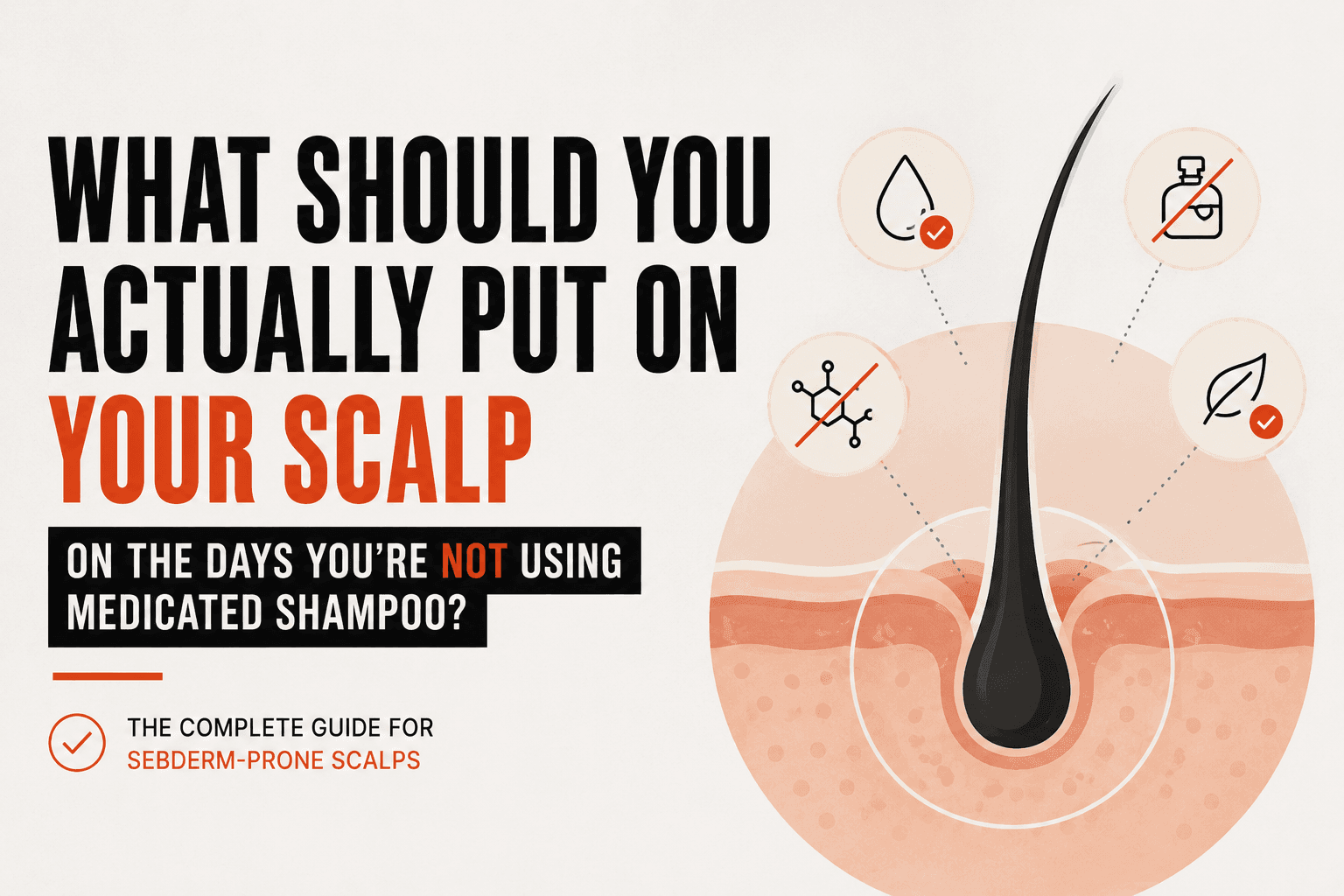
Most people with sebderm leave their off days completely unmanaged. Here's what your scalp actually needs between washes - and why most of what people reach for is making things worse.

If your sebderm keeps flaring even though you're using ketoconazole correctly, the shampoo isn't the problem. Here's what's actually missing from your routine.